
Val's Blog 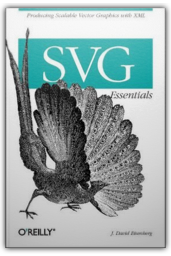
Scalable Vector Graphics — or SVG — is the new XML-based graphics standard from the W3C that will enable Web documents to be smaller, faster and more interactive. J. David Eisenberg's insightful book takes you through the ins and outs of SVG, beginning with basics needed to create simple line drawings and then moving through more complicated features like filters, transformations, and integration with Java, Perl, and XSLT. SVG makes it possible for designers to escape the constant need to update graphics by hand or use custom code to generate bitmap images. While SVG was created with the Web in mind, the language has a variety of other uses. SVG makes it much easier to automate graphics generation, create charts and graphics based on a wide variety of data sources, or create images that users can zoom in on and explore. Whether you're a graphic designer looking for new tools, or a programmer creating and managing graphics, SVG Essentials provides you with a solid foundation. 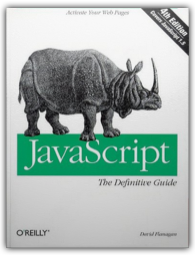
JavaScript is a powerful, object-based scripting language; JavaScript programs can be embedded directly in HTML web pages. When combined with the Document Object Model (DOM) defined by a web browser, JavaScript allows you to create Dynamic HTML content and interactive client-side web applications. JavaScript: The Definitive Guide provides a thorough description of the core JavaScript language and both the legacy and standard DOMs implemented in web browsers. The book also contains detailed reference sections that cover the core JavaScript API, the legacy client-side API, and the W3C standard DOM API, documenting every JavaScript object, method, property, constructor, constant, function, and event handler in those APIs. This fourth edition of the bestselling JavaScript book has been carefully updated to cover JavaScript 1.5. The book also provides complete coverage of the W3C DOM standard (Level 1 and Level 2), while retaining material on the legacy Level 0 DOM for backward compatibility. 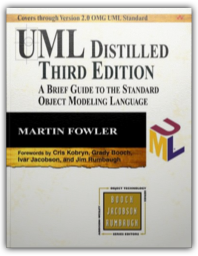
Pressured with tight deadlines, application developers do not have the luxury of keeping completely up-to-date with all of the latest innovations in software engineering. Once in a great while, a tremendous resource comes along that helps these professionals become more efficient. The first two editions of UML Distilled have been perennial best-sellers because of their concise, yet thorough, nature. This eagerly-anticipated third edition allows you to get acquainted with some of the best thinking about efficient object-oriented software design using the latest version of the industry-standard for modeling software: UML 2.0. The author has retained the book's convenient format that has made it an essential resource for anyone who designs software for a living. The book describes all the major UML 2.0 diagram types, what they are intended to do, and the basic notation involved in creating and deciphering them. A true treasure for the software engineering community. 
Four top-notch authors present the first book containing a catalog of object-oriented design patterns. Readers will learn how to use design patterns in the object-oriented development process, how to solve specific design problems using patterns, and gain a common vocabulary for object-oriented design. 
The old saying is wrong-winners do quit, and quitters do win. 
Comprehensive guide to designing Web-enabled databases with XML technology. An essential resource for all database designers/developers, XML application developers, system architects, and project technical leaders. Softcover. |
XML is revolutionizing Web-site development by making difficult tasks easier — and many new tasks possible. Based on the latest W3C standards, this thorough tutorial-plus-reference takes you step by step through everything you need to know to put XML to work, from the fundamentals of the XML language to document construction and simple XML-based solutions for specialized markup problems. Numerous examples, specifications, and addresses for relevant Web sites leave no questions unanswered. 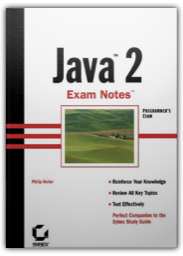
A companion to the Sybex study guide for Java 2, this volume reinforces the reader's knowledge and helps when preparing for the Java 2 programmer's exam. Provides sample questions, defines key terms and concepts, and reviews all of the fundamentals needed to pass the exam. Softcover. 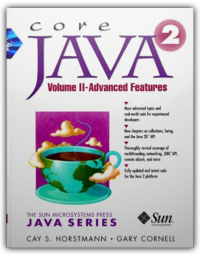
Provides advanced topics and real-world code for experienced developers, a thoroughly revised coverage of multithreading, networking, JDBC API, remote objects, and fully updated and tested code for the Java 2 platform. Softcover. CD-ROM included. 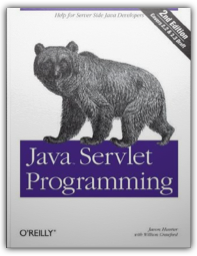
Java Servlet Programming covers everything Java developers need to know to write effective servlets. It explains the servlet lifecycle, showing how to use servlets to maintain state information effortlessly. It also describes how to serve dynamic web content, including both HTML pages and multimedia data, and it explores more advanced topics like integrated session tracking, efficient database connectivity using JDBC, applet-servlet communicaton, interservlet communication, and internationalization. The second edition of this popular book has been completely updated to cover the new features of Version 2.2 of the Java Servlet API. It introduces chapters on servlet security and advanced communication, and also introduces several popular tools for easier integration of servlet technology with dynamic web pages. These tools include JavaServer Pages (JSP), Tea, XMLC, and the Element Construction Set. In addition to complete coverage of the 2.2 specification, we have also added bonus material on the new 2.3 specification. 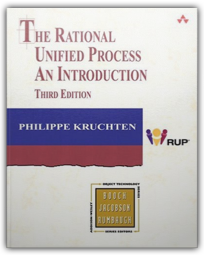
The Rational Unified Process (RUP) is a saleable product from Rational/IBM.The RUP unifes the entire software development team and seeks to optimizethe productivity of each and every team member by putting the collectiveexperience derived from thousands of development projects and many industryleaders at the user's fingertips. It is a very popular product, and this bookrepresents the most thorough documentation for the latest version of theproduct (RUP v2003), which was released in May of 2003. 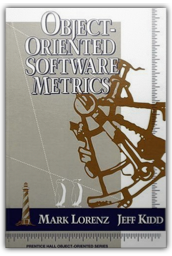
This book provides a number of specific metrics that apply to object-oriented software projects. The metrics are based on measurements and derived advice drawn from a number of actual projects that have successfully used object technology to deliver products. Covers both project completion metrics and design metrics — common, Smalltalk only, and C++ only. For programmers interested in object-oriented technology. |

Steven Pothoven
Collection Total:
178 Items
178 Items
Last Updated:
Nov 2, 2010
Nov 2, 2010

 Made with Delicious Library